1928 · United Kingdom
Gill Sans
Eric Gill's 1928 humanist sans for Monotype — built on classical Roman proportions and his teacher Johnston's Underground type, it became the quintessentially British sans of railways, Penguin books, and the BBC.
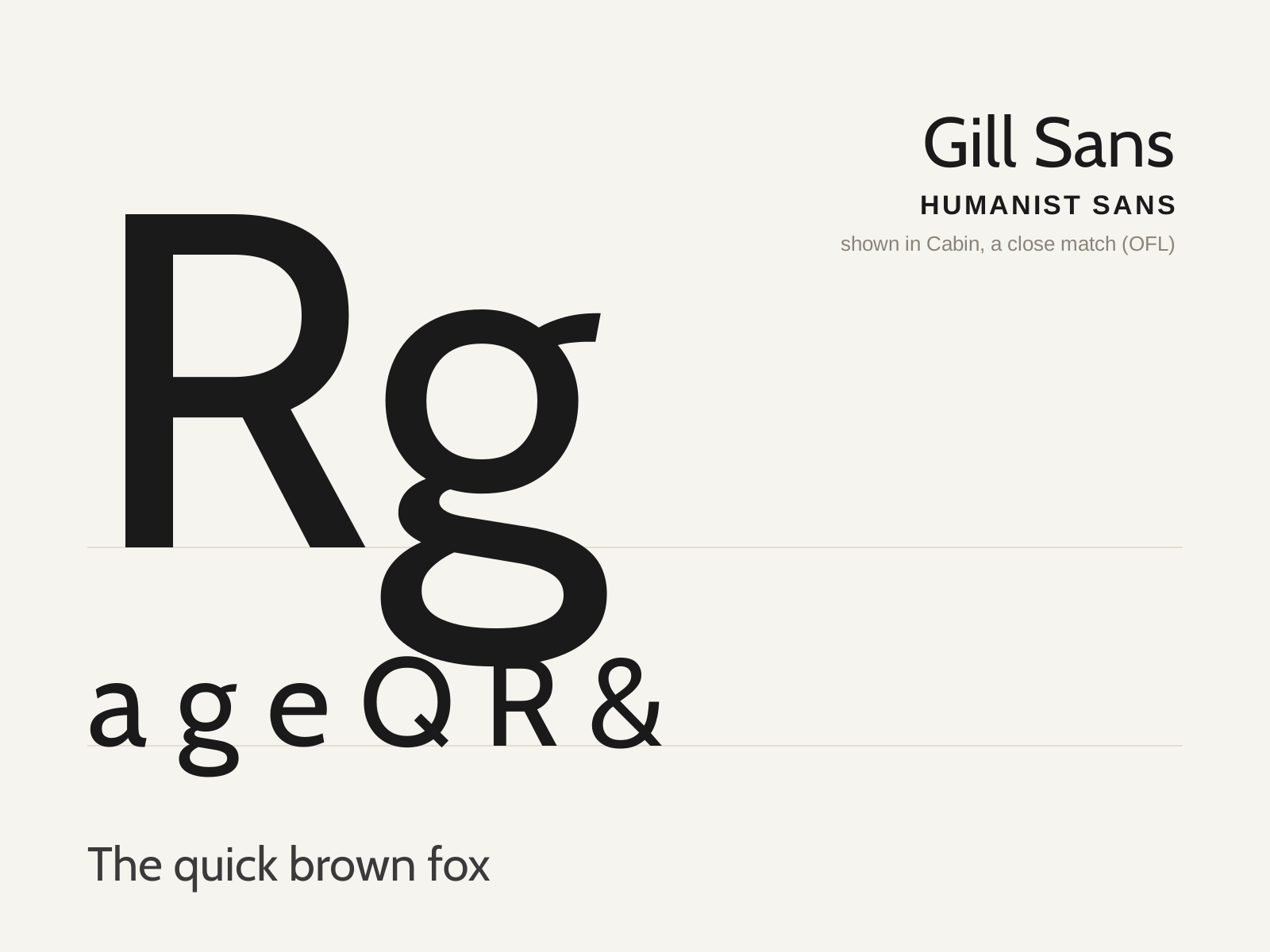
Original specimen, not a historical artifactType specimen — Gill Sans (Humanist sans); shown in Cabin, a close match (OFL). Owned; source: Design Style Book (original specimen).
About the style
Gill Sans was designed by the sculptor and typographer Eric Gill for Monotype in 1928, developed from the lettering of his teacher Edward Johnston (whose 1916 Underground type pioneered the humanist sans) and grounded in the classical Roman capital proportions Gill knew as a stone-carver. Unlike the grotesques and geometrics, its capitals follow the varied widths of the inscriptional Roman alphabet, its lowercase carries a true double-story g and a modest stroke modulation, and its terminals show a calligraphic flick — producing warmth and humanity rather than neutrality or mechanism. It was rapidly adopted as a kind of British national typeface: the LNER railway, Penguin's paperback covers, and the BBC's identity all rode on it. Admired for its elegance in display, though its uneven weights and idiosyncratic lower g make it a less reliable workhorse than later humanist sans like Frutiger.
Notable examples
- ▸Eric Gill — Gill Sans (Monotype, 1928)
- ▸London & North Eastern Railway identity
- ▸Penguin Books covers and BBC corporate identity
Anatomy of Gill Sans
The numbered markers call out the design elements that define this style. Hover or tap a marker to see its breakdown.
Original specimen, not a historical artifactType specimen — Gill Sans (Humanist sans); shown in Cabin, a close match (OFL). Owned; source: Design Style Book (original specimen).
Gill Sans gives its R an elegant, slightly curved leg derived from the Roman inscriptional capital — a humanist gesture, not a straight geometric stroke.
Its double-story g is a hallmark, with a small, neatly drawn lower loop that is one of the most recognizable details in the face.
The double-story a has an open aperture and pen-formed bowl, echoing classical roman type and aiding legibility.
In text Gill Sans reads warm and humane with real personality — elegant for display and signage, if less even than later humanist workhorses.
How Gill Sans connects
Styles form a network, not a tree. Explore the direct neighbours below — click any to travel the map one hop at a time.
- Evolved from
- Influenced by
Hover or tap a style to preview it.
Evolved from Humanist Sans-serif — the canonical British humanist sans
Frutiger influenced by Gill Sans
Compare side by side
Describe it like this
Prompt-ready vocabulary for describing or re-creating the Gill Sans look. Tap a word to collect it in Designdeas.
Get copy-ready Gill Sans AI prompts →