c. 1150–present · Germany, Western Europe, England
Blackletter
Also known as Gothic Script, Broken Script, Gothic Minuscule
The dense, angular family of broken-pen scripts that carried medieval Europe from manuscript to movable type, all dark vertical strokes and fractured curves. Its descendants — textura, rotunda, schwabacher, and fraktur — range from rigid liturgical density to looser vernacular forms.
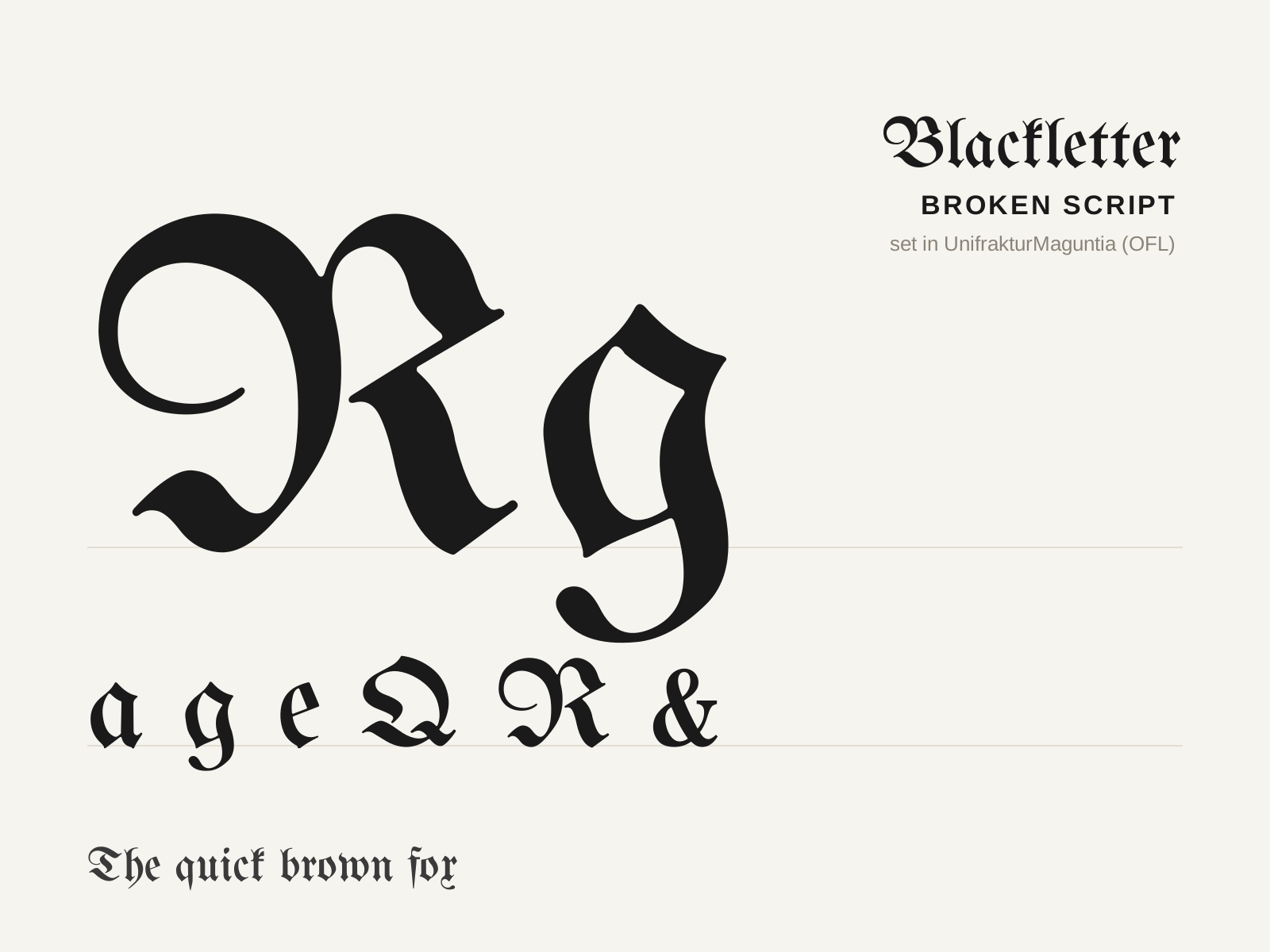
Original specimen, not a historical artifactType specimen — Blackletter (Broken script); set in UnifrakturMaguntia (OFL). Owned; source: Design Style Book (original specimen).
Across disciplines
- Architecture: Gothic Architecture
- Graphic Design: Illuminated Manuscript
- Graphic Design: Incunabula Printing
- Tattoo: Blackletter
About the style
Blackletter is the umbrella classification for the broken scripts that dominated Western European writing and early printing from roughly the twelfth century onward, named for the heavy 'black' color that tight, vertical strokes give to the page. The broad-nibbed pen, held at a steep angle, fractures every curve into angular segments, so that even round letters are built from straight diagonal pen-strokes joined at sharp corners. The family subdivides into textura (the rigid, picket-fence script of Gutenberg's 42-line Bible), rotunda (a rounder Italian variant), schwabacher, and fraktur, which together carried German printing into the twentieth century. Compressed proportions, condensed counters, and diamond-shaped terminals let blackletter pack maximum text onto costly parchment, while later forms added decorative flourishes and hairline embellishments. Outside its liturgical and Germanic homeland the style narrowed to specialist use — newspaper mastheads, diplomas, beer labels, and certificates — where its medieval gravitas still signals tradition and authority.
Notable examples
- ▸Gutenberg 42-line Bible textura (Johannes Gutenberg, c. 1455)
- ▸Fette Fraktur (Johann Christian Bauer, 1850)
- ▸The New York Times masthead (textura-derived nameplate)
Anatomy of Blackletter
The numbered markers call out the design elements that define this style. Hover or tap a marker to see its breakdown.
Original specimen, not a historical artifactType specimen — Blackletter (Broken script); set in UnifrakturMaguntia (OFL). Owned; source: Design Style Book (original specimen).
The capital R is built from angular pen-strokes with a heavy bowl and a sharply kicked, often flourished leg. Its diamond terminals reveal the broad nib's path.
The lowercase g compresses into a narrow, angular figure-eight where the curves are snapped into facets. Counters shrink almost to slits in the dense textura forms.
The lowercase a is a tall, narrow form whose bowl is fractured into straight diagonals rather than a smooth curve. It stands shoulder-to-shoulder with neighbors at minimal spacing.
Set as text, blackletter reads as an even, near-black weave — superb for liturgical gravitas and mastheads, but slow and forbidding at length to modern eyes.
How Blackletter connects
Styles form a network, not a tree. Explore the direct neighbours below — click any to travel the map one hop at a time.
- Parallel / cross-current
- Evolved from
Hover or tap a style to preview it.
Parallel / cross-current Gothic Architecture — the medieval Gothic sensibility expressed in letterform
Illuminated Manuscript parallel / cross-current Blackletter — the broken-pen scripts of the same medieval scriptoria
Incunabula Printing parallel / cross-current Blackletter
Fraktur evolved from Blackletter — the quintessential German blackletter
Blackletter parallel / cross-current Blackletter — applies the Gothic blackletter typographic tradition to skin
Describe it like this
Prompt-ready vocabulary for describing or re-creating the Blackletter look. Tap a word to collect it in Designdeas.
Get copy-ready Blackletter AI prompts →