1957 · France, Switzerland
Univers
Adrian Frutiger's 1957 neo-grotesque — the first type family conceived as a rational, numbered system of 21 coordinated weights and widths, a masterpiece of Swiss order released the same year as Helvetica.
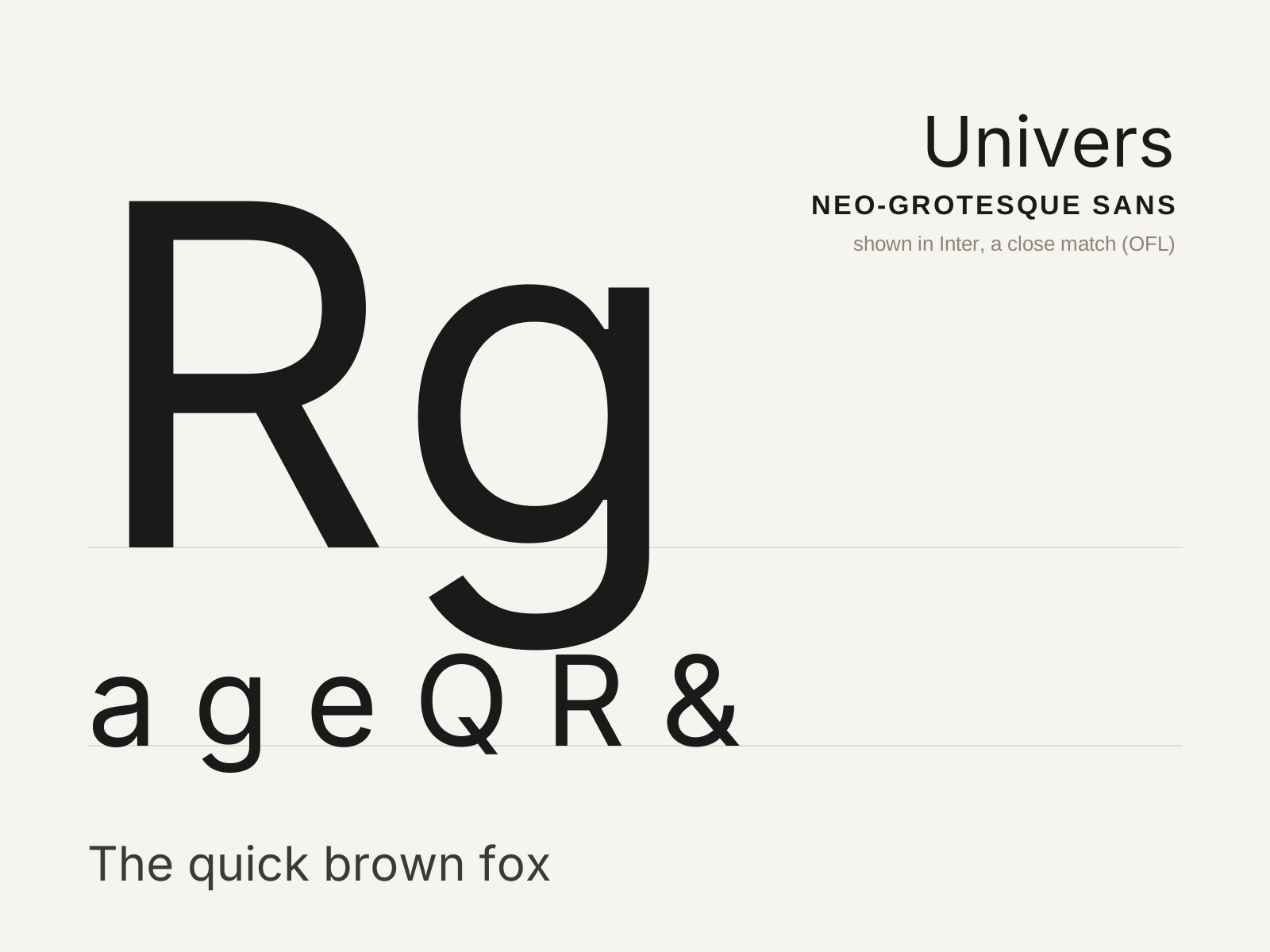
Original specimen, not a historical artifactType specimen — Univers (Neo-grotesque sans); shown in Inter, a close match (OFL). Owned; source: Design Style Book (original specimen).
Across disciplines
- Graphic Design: Swiss Style
About the style
Univers was designed by Adrian Frutiger for the Deberny & Peignot foundry in 1957, the same year as Helvetica, but conceived on a wholly different premise: a single, unified superfamily of 21 coordinated variants organized by a two-digit numbering grid (Univers 55 the roman, 39 the thinnest, 83 the heaviest), so weight and width could be specified rationally rather than by vague names. The letterforms themselves are a refined neo-grotesque with a slightly more even, less mechanical color than Helvetica, a marginally lower x-height, gently splayed R leg, and a subtle taper in the strokes that softens the texture. Adopted as a flagship of the International Typographic Style and later for corporate and signage systems worldwide, Univers demonstrated that a typeface could be engineered as a coherent design system — an idea that reshaped how families are built to this day.
Notable examples
- ▸Adrian Frutiger — Univers (Deberny & Peignot, 1957)
- ▸Univers numbering grid (55 roman, 39–83 system)
- ▸Deutsche Bank and numerous corporate identities
Anatomy of Univers
The numbered markers call out the design elements that define this style. Hover or tap a marker to see its breakdown.
Original specimen, not a historical artifactType specimen — Univers (Neo-grotesque sans); shown in Inter, a close match (OFL). Owned; source: Design Style Book (original specimen).
Univers gives its R a slightly splayed, nearly straight leg — distinct from Helvetica's curled-under leg, a reliable way to tell the two 1957 rivals apart.
It uses a controlled double-story g whose neat lower loop reinforces the family's even, systematic color.
The double-story a has a closed aperture and gently squared bowl, slightly softer and more tapered than Helvetica's.
In text Univers reads slightly more even and refined than Helvetica thanks to its subtly tapered strokes — orderly without feeling quite as mechanical.
How Univers connects
Styles form a network, not a tree. Explore the direct neighbours below — click any to travel the map one hop at a time.
- Evolved from
- Parallel / cross-current
Hover or tap a style to preview it.
Evolved from Akzidenz-Grotesk — Frutiger's systematic neo-grotesque, Helvetica's 1957 rival
Parallel / cross-current Swiss Style
Compare side by side
Describe it like this
Prompt-ready vocabulary for describing or re-creating the Univers look. Tap a word to collect it in Designdeas.
Get copy-ready Univers AI prompts →