1925–1935 · Germany, Switzerland
The New Typography
Also known as Die neue Typographie, Asymmetric typography
The rigorous modernist program codified by Jan Tschichold — asymmetric layouts, sans-serif type, and the functional grid presented not as art but as a rational set of rules for clear, efficient communication.
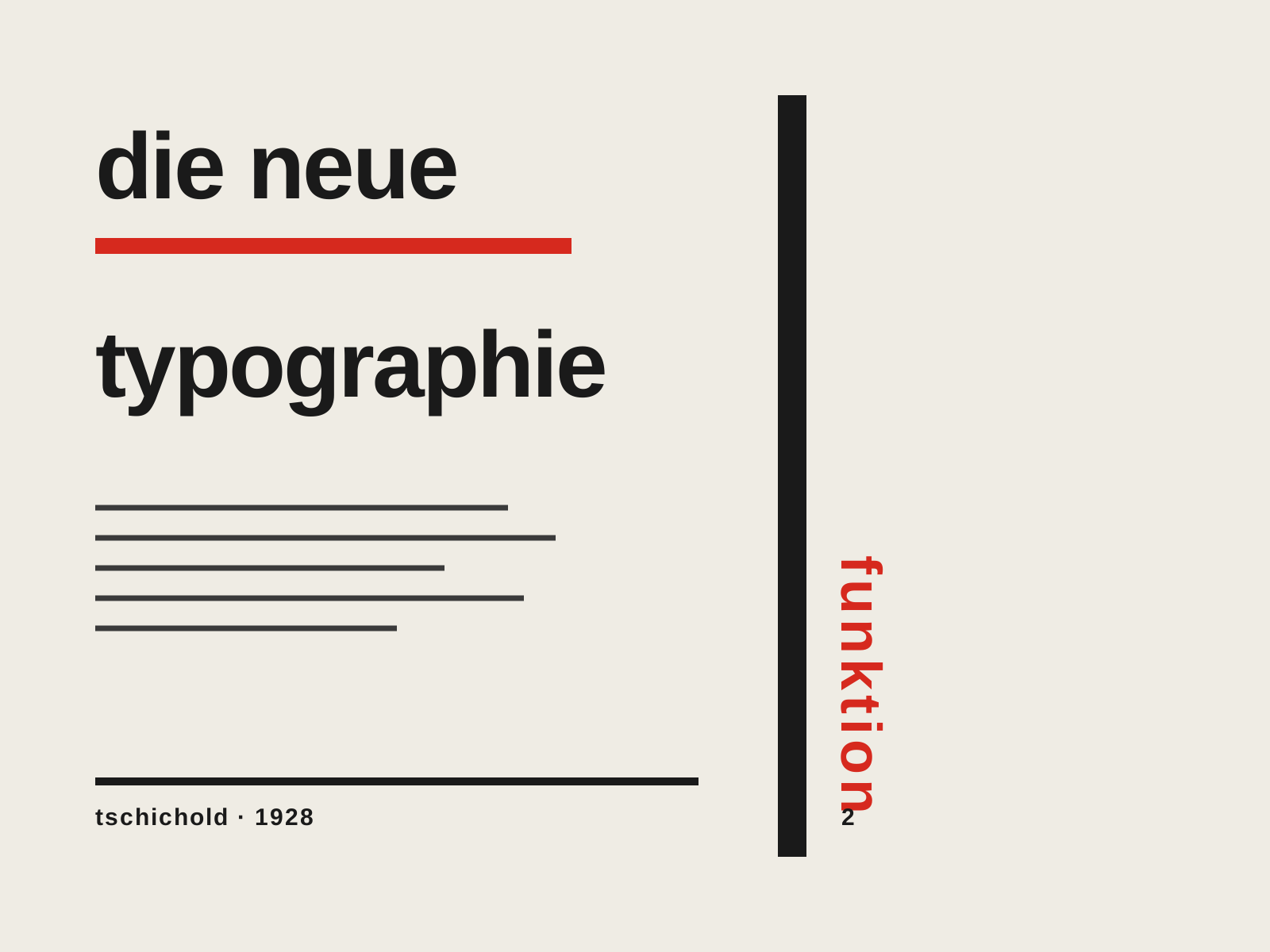
Original specimen, not a historical artifactOriginal specimen in the New Typography style (after Tschichold). Owned; source: Design Style Book (original).
Across disciplines
- Architecture: Bauhaus
About the style
The New Typography was the systematized doctrine that distilled the avant-garde experiments of Constructivism, De Stijl, and the Bauhaus into a coherent, teachable method for everyday print. Its theorist was Jan Tschichold, whose 1925 special issue 'elementare typographie' and 1928 book 'Die neue Typographie' argued that typography's sole purpose was communication, achieved through clarity rather than ornament. Tschichold rejected centered, symmetrical composition and decorative typefaces in favor of asymmetric layout, sans-serif ('grotesque') type, the active use of white space, and an organizing grid in which every element earned its position by function. He embraced standardized paper formats, rules and bars to direct the eye, and photography over illustration. Though Tschichold himself later recanted and returned to classical typography, the New Typography became the doctrinal bridge from the avant-garde to the postwar International Typographic (Swiss) Style.
Notable examples
- ▸Jan Tschichold — Die neue Typographie (1928)
- ▸Jan Tschichold — 'elementare typographie' special issue (1925)
- ▸Jan Tschichold — Phoebus-Palast cinema posters (1927)
Anatomy of The New Typography
The numbered markers call out the design elements that define this style. Hover or tap a marker to see its breakdown.
Original specimen, not a historical artifactOriginal specimen in the New Typography style (after Tschichold). Owned; source: Design Style Book (original).
Text and rules sit off-center and left-aligned, replacing the ceremonial centered page with dynamic balance.
Plain grotesque typefaces are chosen for clarity and modernity over decorative serif faces.
Heavy lines and bars structure the page and guide the reader's eye through the information.
Empty areas are used actively to separate and emphasize, not merely left over as margin.
How The New Typography connects
Styles form a network, not a tree. Explore the direct neighbours below — click any to travel the map one hop at a time.
- Evolved from
- Influenced by
- Parallel / cross-current
Hover or tap a style to preview it.
Evolved from Bauhaus Graphic Design — codified the Bauhaus and avant-garde experiments into a teachable set of rules
Influenced by Constructivist Graphics — took its asymmetry, rules, and sans-serif from Constructivist practice
Influenced by De Stijl Graphics — absorbed the orthogonal grid and elemental geometry
Bauhaus parallel / cross-current The New Typography — the Bauhaus workshop produced the New Typography programme
Swiss Style evolved from The New Typography — carried Tschichold's New Typography forward into a rigorous, total grid system
Modernist Magazine Art Direction influenced by The New Typography
Emigre Digital Type parallel / cross-current The New Typography — the digital heir to the New Typography's experiment
Describe it like this
Prompt-ready vocabulary for describing or re-creating the The New Typography look. Tap a word to collect it in Designdeas.
Get copy-ready The New Typography AI prompts →