1690s–1790s · France, England
Transitional Serif
Also known as Réale serif
The bridge between the pen-formed old-styles and the rationalist Didones. Contrast sharpens and the axis swings toward vertical, yielding crisper, more even letterforms still warmed by bracketed serifs.
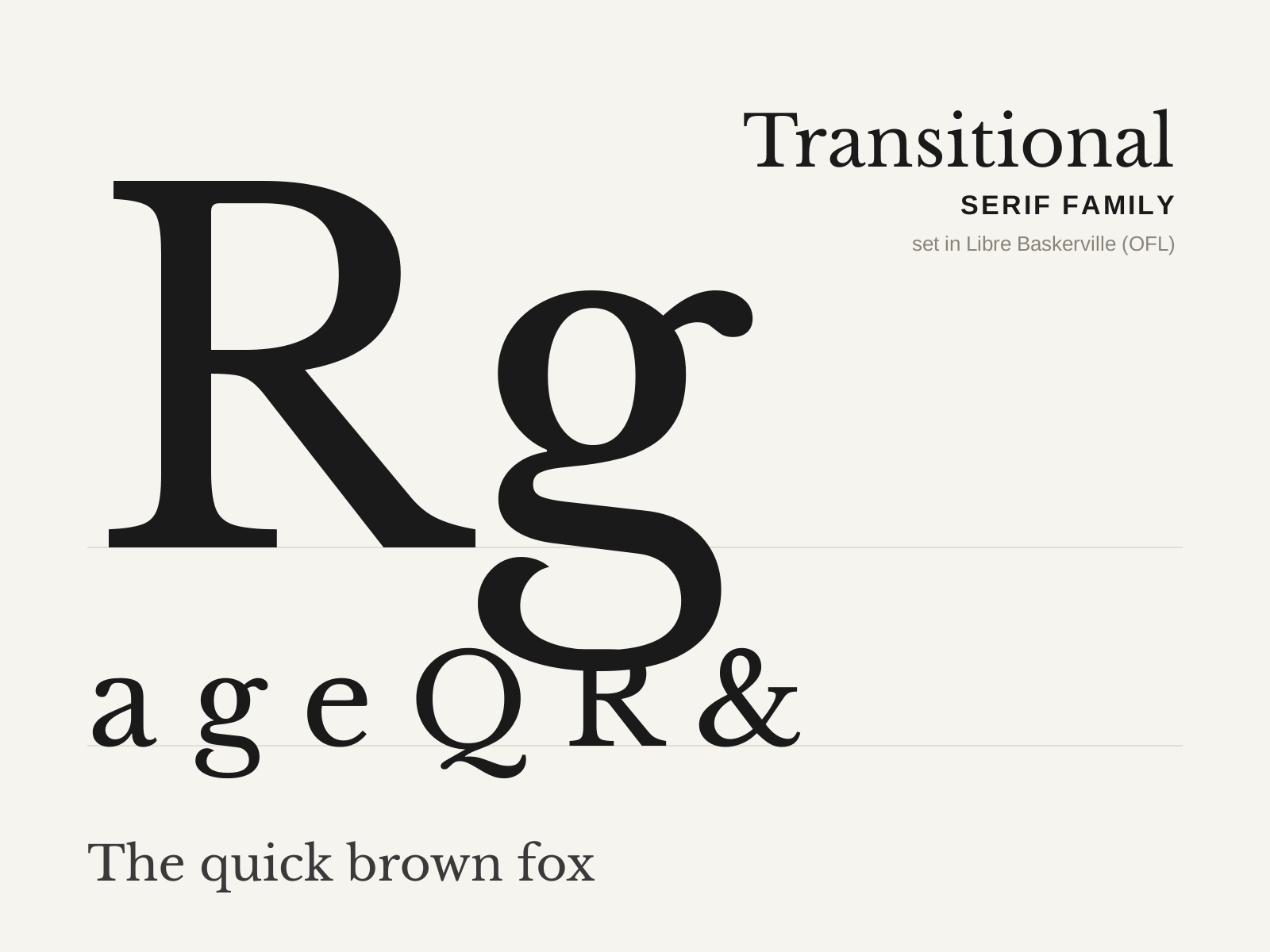
Original specimen, not a historical artifactType specimen — Transitional Serif (Serif family); set in Libre Baskerville (OFL). Owned; source: Design Style Book (original specimen).
About the style
Transitional serifs name the family that stands between the old-style Garaldes and the high-contrast Didones, taking shape from the French Romain du Roi commissioned for the Imprimerie Royale in the 1690s and reaching its English summit in John Baskerville's types of the 1750s. They are defined by an increase in stroke contrast, a stress that swings from oblique toward (but not fully to) vertical, sharper and more refined bracketed serifs, and a general crispness owed to engraving and to Baskerville's smoother papers and blacker inks. Less calligraphic than the old-styles yet warmer and less severe than the Didones that followed, they balance rationalist regularity against residual humanist softness. They matter as the hinge of serif history — the moment type stopped imitating the pen and began answering to the ruler, the burin, and the engraver's eye.
Notable examples
- ▸Romain du Roi — Imprimerie Royale (Philippe Grandjean, 1690s)
- ▸John Baskerville — Virgil (Birmingham, 1757)
- ▸Pierre-Simon Fournier — Fournier types (1740s)
Anatomy of Transitional Serif
The numbered markers call out the design elements that define this style. Hover or tap a marker to see its breakdown.
Original specimen, not a historical artifactType specimen — Transitional Serif (Serif family); set in Libre Baskerville (OFL). Owned; source: Design Style Book (original specimen).
The capital R carries sharply finished bracketed serifs and an open, gently curving leg, its near-vertical stress crisper and more modeled than an old-style R.
The lowercase g is two-storey with a more regularized, evenly weighted loop and a neat ear, reflecting the genre's rationalizing tendency.
The lowercase a is two-storey with a controlled aperture and a small teardrop terminal at the top of the bowl.
Running text reads sharper and more even than old-style — higher contrast and brighter color, equally at home in books and formal printing.
How Transitional Serif connects
Styles form a network, not a tree. Explore the direct neighbours below — click any to travel the map one hop at a time.
- Evolved from
- Influenced by
Hover or tap a style to preview it.
Evolved from Garalde (Old-style) — sharpened contrast and a more vertical stress than the old-style
Didone (Modern) Serif evolved from Transitional Serif — pushed contrast and vertical stress to a rationalist extreme
Baskerville evolved from Transitional Serif — the archetype of the transitional serif
Times New Roman evolved from Transitional Serif
Georgia evolved from Transitional Serif — a screen-tuned transitional serif
Mrs Eaves influenced by Transitional Serif — keeps the moderate contrast and near-vertical stress of the class
Describe it like this
Prompt-ready vocabulary for describing or re-creating the Transitional Serif look. Tap a word to collect it in Designdeas.
Get copy-ready Transitional Serif AI prompts →