1757 · England, Birmingham
Baskerville
Also known as Transitional serif
John Baskerville's 1757 transitional serif — crisper and higher in contrast than the old-styles, with a near-vertical stress and sparkling sharp serifs, printed on his own glossy paper with blacker ink.
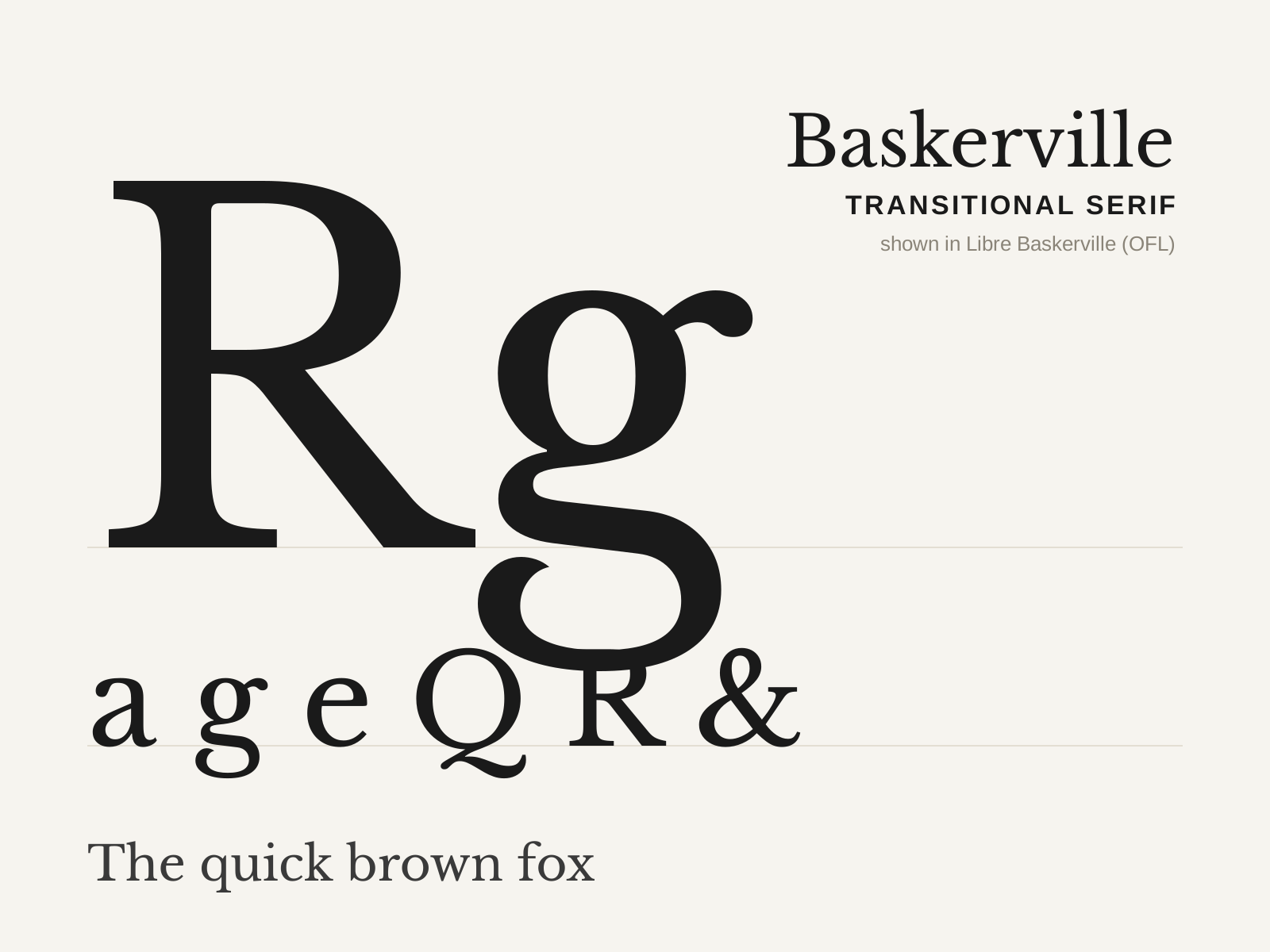
Original specimen, not a historical artifactType specimen — Baskerville (Transitional serif); shown in Libre Baskerville (OFL). Owned; source: Design Style Book (original specimen).
About the style
John Baskerville, a Birmingham writing-master and japanning manufacturer, cut his transitional roman around 1754 and used it in his celebrated 1757 edition of Virgil. The type raised stroke contrast above the old-styles, swung the axis of stress toward vertical, and sharpened the bracketed serifs into something crisp and gleaming — an effect Baskerville heightened with smoother wove paper, blacker ink, and hot-pressing that made the pages almost shine. Diagnostic features include the open lowercase 'g' with its lower loop left unclosed, the elegant flourished tail on the capital 'Q', and teardrop terminals on letters like 'a' and 'c'. Initially criticized in England as dazzling and hard on the eyes, it was admired by Benjamin Franklin and the French, and now stands as the defining transitional face — the hinge between Caslon's old-style warmth and the Didone's cold brilliance.
Notable examples
- ▸John Baskerville — Virgil (Birmingham, 1757)
- ▸John Baskerville — Cambridge Bible (1763)
- ▸Bruce Rogers / Monotype — Baskerville revival (1923)
Anatomy of Baskerville
The numbered markers call out the design elements that define this style. Hover or tap a marker to see its breakdown.
Original specimen, not a historical artifactType specimen — Baskerville (Transitional serif); shown in Libre Baskerville (OFL). Owned; source: Design Style Book (original specimen).
Baskerville's capital R has a rounded bowl and an elegantly curved, outward-sweeping leg on sharply cut bracketed serifs, its stress nearly vertical.
The lowercase g is two-storey but distinctive: its lower loop is left open rather than closed, with a graceful ear — a Baskerville signature.
The lowercase a is two-storey with a moderate aperture and a teardrop terminal at the top of the bowl, crisper than an old-style a.
Running text reads brighter and sharper than old-style — higher contrast and clean serifs giving the page Baskerville's famous gleam.
How Baskerville connects
Styles form a network, not a tree. Explore the direct neighbours below — click any to travel the map one hop at a time.
- Evolved from
- Influenced by
Hover or tap a style to preview it.
Evolved from Transitional Serif — the archetype of the transitional serif
Influenced by Caslon
Times New Roman influenced by Baskerville
Georgia influenced by Baskerville
Bodoni influenced by Baskerville — pushed Baskerville's contrast to the limit
Didot influenced by Baskerville
Mrs Eaves evolved from Baskerville — an interpretation of John Baskerville's transitional serif
Describe it like this
Prompt-ready vocabulary for describing or re-creating the Baskerville look. Tap a word to collect it in Designdeas.
Get copy-ready Baskerville AI prompts →